|
Plants shrub-like to subarboreous, usually densely clumping; rhizomes pachymorph, necks similar in length, up to 30 cm, internodes short. Culms in a single dense to loose clump (unicespitose), to 8 m tall and 4 cm in diam., erect or curving at base, apically nodding to pendulous; internodes to 50 cm, terete, usually finely ridged, without fine purple spots, usually blue-grey with light to dense and persistent wax, matt or becoming glossy, usually partially setose or pubescent, especially at top; nodes scarcely to moderately raised. Branches 3--7 per mid-culm node at first, above promontory, subequal, deflexed, or basally erect but arching out, lateral branch axes lacking subtending sheaths; buds at mid-culm lanceolate, with 2 often very tall, single-keeled bracts, open at front (closed at culm base), 3--9 initials visible within. Culm sheaths usually long-triangular, papery and deciduous (rarely oblong, thickened and persistent); blades long, reflexed, deciduous. Leaf sheaths usually persistent; blade usually matt, thin, venation distinctly tessellate, either persistent or deciduous in winter. Synflorescence semelauctant; branching racemose to paniculate, subtended by small sheath remnants, not pulvinate, not unilateral, at least partially exserted beyond subtending sheaths by well-extended internodes of peduncle, rhachis and pedicels. Spikelets few, several-flowered; glumes basally loose, and frequently subtending reduced non-viable buds. Stamens 3. Stigmas 3. Named after Norman L. Bor, forester and grass taxonomist of the Indian Forest Service and the Royal Botanic Gardens Kew.
Borinda is a temperate to subtropical genus that currently contains nearly 50 species, native to the Sino-Himalayan mountains from C Nepal to N Vietnam and W Sichuan. Many species have high local economic value and great horticultural potential. They are often indigenous to dwindling forest areas or individual mountain tops, and are thus potentially threatened with extinction as forests are cleared and climate change pushes species up the mountains.
Large stature hardy clump-forming bamboos are the holy grail of bamboo horticulture. Hardy species in Fargesia and Thamnocalamus are rather small, while larger species such as those in Bambusa, Ampelocalamus and Himalayacalamus are not sufficiently hardy. Therefore I was excited to encounter a hardy species in the snow in Bhutan in 1985, taller than the houses, and producing substantial culms from well-behaved clumps which, unlike like those of Phyllostachys or Yushania, will not spread widely. The genus Borinda was published in 1994 for Himalayan species. From 1992 species have been introduced to the west from Tibet, Nepal, Arunachal Pradesh, Yunnan, Sichuan and Vietnam.
Borinda flowers are in more primitive racemes or racemose panicles than the derived highly compressed unilateral racemes of Fargesia, e.g. those of Fargesia murielae. The internodes of the inflorescence are elongated enough for the longer peduncle and rhachis to project the inflorescence partially or completely beyond the preceding leaf sheaths, and the longer pedicels separate the spikelets well. Compared to Fargesia, the spikelets themselves are longer with more numerous florets that are often more flattened and distichous. The leaves are usually thinner, less glossy, and lighter green. The culms of Borinda species are usually finely ridged, without spots, often scabrous or hairy, in contrast to the glossy glabrous spotted culms of Fargesia. The culm sheaths are either longer and more triangular than Fargesia, or more thickened and persistent in species with deciduous leaf blades. Similar to Yushania as well, but the rhizome necks are shorter and more consistent in length, producing single clumps and not running, having fewer internodes on the rhizome neck, each shorter than its width. The leaf blades are arranged in a more regular fashion.
Most of the species were described relatively recently, mostly without flowers, and nearly all were initially placed in a polyphyletic Fargesia. China had many poorly-known species described in Fargesia that might or might not have been species of Borinda. Therefore, in the Flora of China account species of Borinda were temporarily included in Fargesia, to keep them all in the same place, rather than dividing them between Fargesia and Borinda. However, DNA analysis and better knowledge of vegetative characters and generic distinctions have now revealed clearly which species needed transferral into Borinda or other genera and new combinations for them have been published.
Borinda species are still often included in a broad interpretation of a polyphyletic Fargesia, or more rarely included in the spreading genus Yushania. Early DNA analyses could not separate known and putative species of Fargesia, Yushania and Borinda well (see Fig 1, from Guo et al. 2001; Fig 2, from Guo & Li 2004). Later results using ddRAD-seq data however clearly showed that these genera correspond to 3 groups that are genetically distinct. Inspection of vegetative characters supported the putative affiliation of many Fargesia species in Borinda (Fig 3, adapted from Ye et al. 2019). Therefore, these species have now been transferred, following an inferred phylogeny and generic classification. It is notable that Yushania and Borinda can be distinguished so clearly from DNA. This reflects the possession of long rhizome necks with extended internodes, and is a much clearer phylogenetic distinction than many expected. While Yushania and core Fargesia are demonstrably monophyletic, no analysis so far has resolved Borinda (as circumscribed by the morphological states above) as monophyletic rather than paraphyletic to Yushania. However, this is also the case with many well-recognised genera and groups in the plant and animal kingdoms. Evolution of a new genus or group, such as Yushania, often makes the genus it has evolved from paraphyletic. Over time only monophyletic groups remain after extinction of older members. Similarly, maybe over time only monophyletic genera will be recognized, after extinction of older taxonomists who still champion recognition of paraphyletic genera.
One group of small, hardy Borinda species have very deciduous leaves in the coldest months. Although many bamboos shed a proportion of their leaves before winter, the routine annual fall of nearly all the leaf blades, as seen in these species, is unusual in the woody bamboos. Associated with thickened, more persistent sheaths and high altitude habitats up to 4000m, this would appear to be an adaptation to extreme cold and hence low water availability. The branching of such deciduous species is more erect, starting within the confines of very tough, persistent culm sheaths, and the internodes are consequently flattened to slightly sulcate above the branches. None of these species have auricles or oral setae on the leaf sheaths. Spikelets are dark and narrower, and their rhizome necks can be longer relative to culm size. B. emeryi from the Himalayas, and several Chinese species such as B. frigidorum and F. melanostachys seem to fall in this group.
Guo et al. (2001). Guo, Z.-H., Chen, Y.-Y., Li, D.-Z., and Yang, J.-B. 2001. Genetic variation and evolution of the alpine bamboos (Poaceae: Bambusoideae) using DNA sequence data. Journal of Plant Research 114: 315-322.
Guo & Li (2004). Guo, Z.-H., and Li, D.-Z. 2004. Phylogenetics of the Thamnocalamus group and its allies (Gramineae: Bambusoideae): inference from the sequences of GBSSI gene and ITS spacer. Molecular Phylogenetics and Evolution 30: 1-12.
Stapleton, C.M.A. (1998). New combinations in Borinda (Gramineae–Bambusoideae). Kew Bull. 53: 453–459.
Stapleton, C.M.A. (2000). New half-hardy bamboos from the Sino-Himalayan region. Amer. Bamboo Soc. Newsl. 21 (4): 16–21, with Bor biography
Stapleton, C.M.A. (2006). New taxa and combinations in cultivated bamboos (Poaceae: Bambusoideae). Sida 22(1): 331–332.
Ye, X.Y., Ma, P.F., Yang, G.Q., Guo, C., Zhang, Y.X., Chen, Y.M., Guo, Z.H. and Li, D.Z. (2019). Rapid diversification of alpine bamboos associated with the uplift of the Hengduan Mountains. Journal of Biogeography 2019; 00: 1– 12 https://doi.org/10.1111/jbi.13723
Stapleton, C.M.A. (2021). We need to talk about Fargesia: new combinations and a new genus in the temperate Sino-Himalayan bamboos (Poaceae: Bambusoideae). J. Amer. Bamboo Soc. 31: 1-16.
|
|






























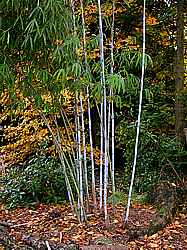
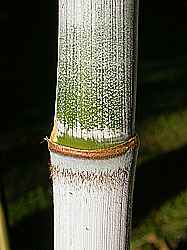
 "A deciduous species in winter")
