|
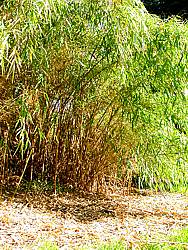
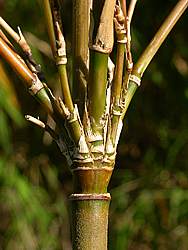
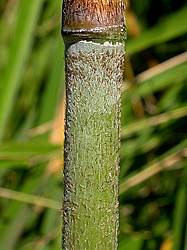
Plants shrub-like, spreading to form diffuse and/or dense clumps; rhizomes pachymorph with variable necks up to (0.3–)0.5(–2) m long, the internodes very many and longer than their width. Culms pluricespitose, 1.5–5 m tall, 0.5–3 cm thick, basally erect; internodes 15–40 cm, terete, often scabrous, distally more densely so, usually not ridged, often waxy at first, usually grey-green, remaining matt; nodes scarcely to moderately raised. Branches 5–7(–15) per mid-culm node at first, above promontory, subequal, initially erect, becoming deflexed, lateral branch axes lacking subtending sheaths; buds at mid-culm lanceolate, with 2 often very tall, single-keeled bracts, open at front, 3–9 initials visible within. Leaf sheaths persistent; blades usually thickened, usually glossy above, venation tessellate, persistent in winter and not deciduous. Synflorescence ebracteate, semelauctant; branching paniculate, often deflexed, often with pulvini but with little or no fasciculation; branches subtended by minute sheath remnants or rings of hairs. Spikelets with 4–10 florets, glumes tight or loose, rarely subtending reduced non-viable buds. Stamens 3. Stigmas 3. Named after Yu Shan (Jade Mountain), the highest mountain in Taiwan (called Niitakayama by the Japanese), on which the type species, Y. niitakayamensis is found.
Yushania is a spreading, warm temperate to subtropical genus that currently contains around 90 species, occurring from the NW Himalayas to Taiwan and the Philippines. The genus differs from Borinda principally in having long-necked rhizomes that enable the plants to spread further, giving a semi-running, pluricespitose habit under suitable conditions. The species are mainly of little utility, and several species are even considered invasive weeds. The dense pendulous mass of foliage can provide good screening but Yushania species can be invasive in warmer sites and are consequently not widely planted as ornamental plants in the UK.
Speculation about the likely flowers of the Fountain Bamboo Arundinaria nitida Mitford in the 1980s led to the inappropriate and temporary use of the older name Sinarundinaria for this genus, because A. nitida is the type species of Sinarundinaria, and it was thought (wrongly) that it would have flowers like those of Yushania. Flowering of A. nitida in the 1990s revealed that it has flowers that place it, and thus the generic name Sinarundinaria, firmly in Fargesia instead. Some who had predicted open flowers for Arundinaria nitida and championed use of Sinarundinaria rather than Yushania then proposed changing the type of A. nitida from a collection of the Fountain Bamboo to a collection of a different, spreading Yushania species, Y. confusa, but this was not accepted
Elongation of the rhizome neck is effected by an increase in the number of internodes and the amount of elongation of each internode, so that many of them are longer than their breadth. This has allowed Yushania species to succeed away from the steeper mountain slopes on which their ancestors developed onto flatter ground that is wetter and softer, through which the long rhizomes can colonize and dominate rapidly. These sites however have less air movement than the mountainsides, and the inflorescences have become larger, with more branches that spread more widely through axillary pulvini, allowing more effective wind-pollination. Rhizome necks are also often hollow, which like the air canals of Arundinaria, may improve oxygenation for the roots in waterlogged ground.
|