|
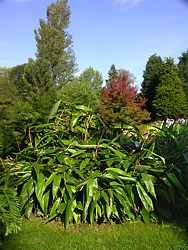
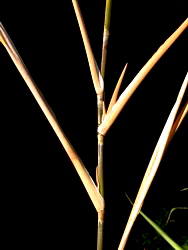
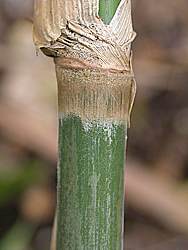
Plants shrub-like, in dense spreading clumps; rhizomes leptomorph. Culms to 2(-5)m tall, self-supporting, diffuse to pluricespitose, nodding to pendulous; internodes terete or very shallowly grooved above branch, with persistent yellow-brown scurfy wax immediately below the nodes, smooth or finely ridged, mainly terete, only slightly flattened immediately above the branches; nodes not swollen, the supranodal ridge not well developed. Branches erect, usually solitary, long, basal nodes compressed, any lateral branches usually arising from more distal nodes, branches fully sheathed, sheaths and prophylls persistent, tough, more or less glabrous; buds closed at front, prophylls 2-keeled. Culm sheaths tough and very persistent, appressed to the culm; blades deciduous, small, articulating, lanceolate, erect or reflexed. Leaf sheaths: centrally thick and leathery, very persistent; blade thick, usually large relative to culm size, to 60 cm, with prominently tessellate venation. Synflorescence semelauctant, ebracteate, branching open, paniculate, erect to deflexed, pubescent. Spikelets narrow, with several to many florets; glumes basally tight, without subtended buds; lemmas acute, unawned; paleas not exceeding the lemmas, 2-keeled. Stamens 3. Stigmas 2; fruit a caryopsis. Name from the Greek indos, ‘Indian’, applied in a very broad sense, and kalamos, ‘reed’.
A genus of approximately 25 mainly Chinese species. Difficult to distinguish from other single-branched genera. Unlike Pseudosasa japonica, they have 2 stigmas instead of three and usually have apically yellow-brown scurf on the internodes, and differing from species of Sasa in their 3 stamens and more random leaf arrangement without marginal winter necrosis (white edges). Only the very large-leaved species are in wide cultivation, the others having little horticultural merit. A species is in cultivation under the misapplied name Indocalamus solidus, which is a synonym of the tropical bamboo Bonia saxatilis, but it is not yet properly identified. Correllation between names in use in China and those in use for plants in cultivation abroad is not satisfactory. One Japanese species is known, I. hamadae, and it differs from the Chinese species in having 2-3 branches.
|